FREE LANGUAGE ARTS LESSON – “Conversational English for Adults – Free unfinished lessons”
by LessonSpeak
11th – 12th Grade
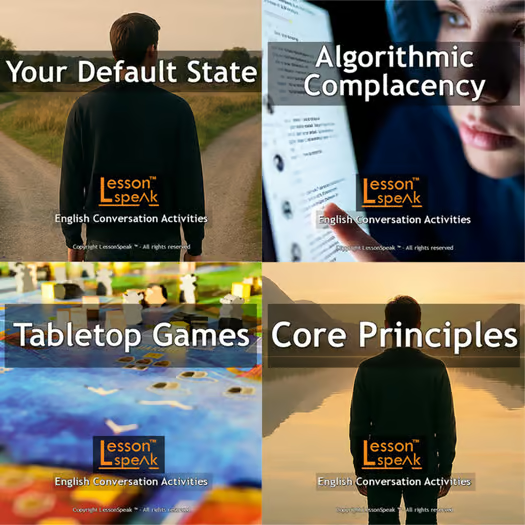
NOTE: THESE ARE UNFINISHED PRODUCTS!
This is a package of 4 lessons that are unfinished. The editable ppt files have been lost so I am releasing them in their current state (with mistakes and all).
Topics:
– Core principles
– Algorithmic complacency
– Your Default State
– Tabletop Games
PLEASE: These lessons have mistakes. If you find a mistake or feel that there is room for improvements, please let me know in the “Ask a Question” section (rather than rate the entire document badly).
Perfect for teachers who want to:
- Run engaging business English conversation classes for adults
- Teach practical financial vocabulary in real-world contexts
- Encourage confident speaking about money and budgeting
- Offer a high-interest, career-relevant topic for professional learners
Lesson Length: 4 hours
Contains:
- 4 full lessons in JPEG format
- Structured speaking prompts & vocabulary exercises
………………………………………………………………………………………………………………………………………………
** Subscribers to my newsletter got this topic for free! ** Get future topics for free + a free starter pack by subscribing here!
………………………………………………………………………………………………………………………………………………
The easiest conversational lesson you’ll ever give! Simply follow these steps:
1.) Open the content
2.) Join video chat with student(s) & share screen
3.) Ask your student(s) to read directly off the slides & correct them where needed
4.) Watch the clock!
………………………………………………………………………………………………………………………………………………
Underlying teaching and learning strategies in this lesson:
1. Communicative Language Teaching (CLT)
- Strategy: Focus on real-life communication through open-ended questions (e.g., “How does slow-travel foster authenticity?”) and scenario-based tasks (e.g., planning a 1-month stay in a new city).
- Purpose: Encourages learners to use English for meaningful interaction, prioritizing fluency and contextual application over isolated grammar drills.
2. Task-Based Language Teaching (TBLT)
- Strategy: Learners complete tasks like defining terms (e.g., geo-arbitrage), matching vocabulary, and describing images.
- Purpose: Promotes problem-solving and practical language use, aligning language goals with real-world objectives (e.g., cultural immersion).
3. Content-Based Instruction (CBI)
- Strategy: Integrates language learning with thematic content (slow travel, sustainability, minimalism).
- Purpose: Makes lessons engaging by connecting language practice to meaningful topics, fostering both linguistic and cultural competence.
4. Scaffolded Learning
- Strategy: Gradual progression from structured activities (readings, term definitions) to independent application (scenarios, reflection questions).
- Purpose: Builds learner confidence by incrementally reducing support, following a “I do, we do, you do” model.
5. Explicit Vocabulary Instruction
- Strategy: Matching exercises (e.g., authenticity → genuine interactions) and contextual use of specialized terms.
- Purpose: Enhances retention of domain-specific vocabulary (e.g., serendipity, bottleneck) through direct teaching and application.
6. Visual Learning
- Strategy: Use of images for descriptive tasks (e.g., “Describe the image in detail”).
- Purpose: Supports visual learners and expands descriptive language skills by linking vocabulary to visual stimuli.
7. Affective Strategies
- Strategy: Emphasis on resilience, self-discovery, and personal growth in questions (e.g., “How does slow-travel help build resilience?”).
- Purpose: Addresses learners’ emotions and attitudes, reducing anxiety and fostering a positive, holistic learning environment.
8. Spiral Curriculum Design
- Strategy: Prerequisites reference prior lessons (minimalism, networking), implying recurring themes.
- Purpose: Reinforces foundational concepts over time, deepening understanding through interconnected topics.
9. Corrective Feedback
- Strategy: Coaches provide feedback during reading aloud and discussions.
- Purpose: Balances fluency and accuracy by addressing pronunciation, vocabulary, and grammar in context.
10. Higher-Order Thinking Skills
- Strategy: Questions requiring analysis (“How does slow-travel challenge conventional tourism?”) and evaluation (“What sacrifices are needed for slow-travel?”).
- Purpose: Develops critical thinking and extended discourse, aligning with Bloom’s taxonomy.
11. Time Management & Cognitive Load Theory
- Strategy: Suggested segmentation of the lesson into timed phases (e.g., warm-up, discussion, review).
- Purpose: Prevents cognitive overload and maintains engagement through structured pacing.
This summary was generated by an LLM with full context of the lesson
………………………………………………………………………………………………………………………………………………
Recent LessonSpeak lessons:
*****************************************************************************
IMPORTANT
Every new product I post in my shop comes out at 20% off for the first 4 days!
To find out and grab it while it is still discounted, click the green star ★ on the top right-hand corner of any page and become a follower, or Click here
• You will also receive customized email updates about this store.
*****************************************************************************
HOW TO GET TPT CREDIT FOR FUTURE PURCHASES: If you enjoy this product, please leave positive feedback to gain credits for future purchases!
Go to your “My Purchases” page. Next to each purchase, you’ll see: “Provide Feedback”. Click it and it will take you to a page where you can give leave a short comment about the product.
Each time you give feedback, TPT gives you feedback credits that you may use for future purchases. Please take the time – feedback is so important!
*******************************************************************************
IF YOU ARE PLANNING ON BUYING THIS PRODUCT, PLEASE READ THIS:
The products in this shop are created by the LessonSpeak team and me (Johnny Ilca), an entrepreneur who happens to teach. Inspiration for these products came from my own personal struggles as a freelance online English teacher. I used to work at iTutorGroup and when I left the company, I struggled in finding quality material to continue teaching in that way. I paid freelancers on Upwork to make some for me but they were of poor quality and had wayyyyy too many mistakes. That is when I took it upon myself to create the best resources not just for myself but for all online English teachers! I am my very first and most loyal customer so you know that these materials have been vetted. However, I am only one person and everyone makes mistakes…
Get a free product if you send me the errors to correct!
I hope this product delivers everything you hoped for and more.
******************************************************************************************
For problems and questions, suggestions or idea sharing, I would LOVE to hear from you – contact me at: lessonspeak1337@gmail.com
******************************************************************************************
Do a quick survey and get a free topic! Click here

Join The Best of Teacher Entrepreneurs Marketing Cooperative at
https://thebestofteacherentrepreneursmarketingcooperative.net/the-best-of-teacher-entrepreneurs-marketing-cooperative-one-year-membership/
and get THOUSANDS OF PAGE VIEWS for your TpT products!
Go to http://www.pinterest.com/TheBestofTPT/ for even more free products!